Time to read: 11 minutes
In this week’s newsletter:
The Timbit Times
Kate Film Club, 4 of 52: “Little Women”
Kate Film Club, 5 of 52: “Spitfire”
Book of the Week: “Thinking in Bets”
French Study
My Year of Ne’er-do-well-ism
Well, it’s been quite the fortnight. I missed last week’s “Week In Review” because I was very, very sick. My fatigue, muscle weakness, and standing tolerance were a lot worse, and there were a couple days where my brain fog became so bad I was effectively concussed—it was only with great effort that I was able to put sentences together. When I looked at my notes though, I realized I’d been in an almost imperceptibly slow worsening since mid-December, for 5 weeks or so. That led me to suspect a particular medication we had added around then. I did some research on what other mechanisms this medication does in the body besides the intended one, and found one thing in particular that could be the culprit. I stopped the medication on Saturday (eight days ago), began feeling better the next day, and have continued to improve all through this week.
I had my regular monthly appointment with my doctor on Tuesday; he agreed with my hypothesis about the medication I’d stopped, and had some new test results to discuss that possibly corroborate the hypothesis, too. But more importantly, these new test results point to a few things we need to get in order (like severe micronutrient deficiencies) before I begin treatment for Lyme. I’m a little disappointed to be putting off Lyme treatment further, but I’m happy to be improving for the moment and to get a few weeks of trying things that are low risk (like vitamins), that will either help or do nothing. Much better than the prospect of Lyme treatment which is more in the category of “could totally fuck me up even worse or could cure me back to full health, who knows!”.
If that sounds stressful—it is! Having a complex illness that has been terribly under-researched by our institutions comes with a lot of high-stakes experiments and choices. This is why my monthly reading theme for February is “decision-making”. I’m excited to share my first book review from this theme below! And for folks who are here more for the Katharine Hepburn movie reviews—don’t worry, I made this week a double-header to stay caught up with my goal of watching all 52 Katharine Hepburn movies this year.
The Timbit Times
I want to take a moment to share what I think is my top self-discovered tiny home living tip so far: using 3M strips to try out the placement of hanging objects before committing to drilling something in the wall. When you live in a very small space, the usage of every square inch becomes strategic. There are some things that you can’t know how they’ll work until you try them, and once you do, you may find yourself wishing you had installed the thing just a few inches to the left. (Or up or down, or just not in a given corner altogether.) This is where 3M strips really shine!
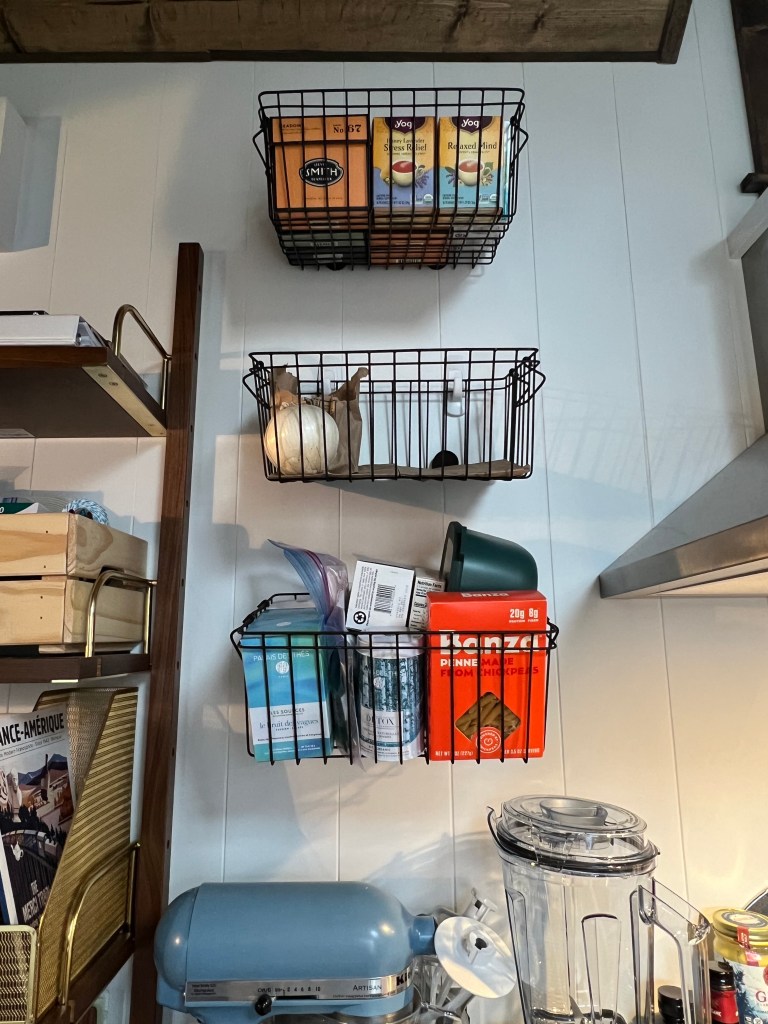
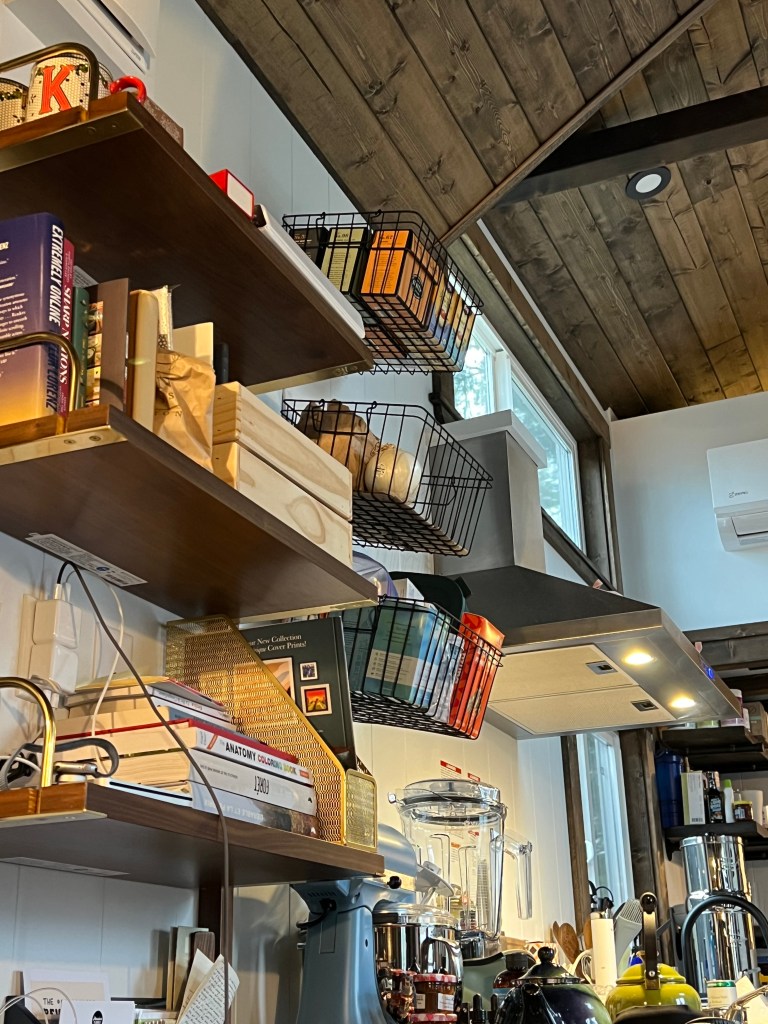
I have a few 3M hooks that have been doing heavy duty work in my bathroom and entryway, and I’ve decided I like where those ones are—they’ll be getting permanently installed hooks soon. But recently I also hung some metal wire baskets in my kitchen, for extra storage space, and I’ve decided I really dislike them there! With the bookshelves I’ve had installed in the living space, it’s just too much stuff on the wall altogether. So I think I’m going to rearrange other kitchen storage, so the items in the baskets can go in drawers, and I have a print that I’d like to get framed and put on the wall instead.
Kate Film Club, 4 of 52:
“Little Women” (1933)
I realized I haven’t fully explained why I chose this goal: yes, I wanted 2024 goals that I could mostly still do even if I’m sick, but I chose “watch every Katharine Hepburn movie ever” in particular because I’m named after Katharine Hepburn! Yet I had never watched any of her movies until watching a couple in December last year. (And I loved them!) That’s been the funny thing about my illness—while it’s preventing me from doing a lot of things, there are a few things here and there that I’m finally getting time to do, because they’re the only things I can do. So anyway, that’s the backstory.
“Little Women” is a film adaptation of the well-known book. I could have sworn I read the book in childhood?, but I was surprised by all the plot developments so…who knows. (I’m the sort of person to read a little way into a book, decide it’s not for me, and walk away from it—perhaps that was the case here.) Hepburn of course was a natural as Jo March, and along with the previous film, I’m quickly realizing one of my favorite things to watch Katharine Hepburn do is play a character that themselves is acting, like in a play inside the movie, for example. She’s a great actress, and an even more mesmerizing meta-actress.
While it was fun to watch her act, I felt underwhelmed by the story. I think there are always challenges when adapting a book for the screen, and that also caused some minor issues here: sometimes we jumped an unknown but significant amount of time between scenes or story arcs, and you have to pick up on frustratingly minimal context clues to keep up.
Rating: 2/5 – Not terrible, just not my cup of tea. If you’re generally a fan of “Little Women”, though, I think it’s worth a watch so you can compare with the other adaptations.
Where to watch: Streaming on Apple and Amazon.
Quote: “Only who knows what longing is, can know what I suffer.”
Kate Film Club, 5 of 52:
“Spitfire” (1934)
Folks, I am writing this review right after the end credits and I…have no idea what I just watched. Was it a dramedy with a side of rom-com? A coming of age story? An Appalachian gothic horror? I had a good laugh at the end credits because, well, I’m a millennial and I have a soft spot for non-sequiturs. Perhaps that’s it: it was a non-sequitur potpourri, with some interesting philosophizing on the nature of faith and prayer. Yeah, that’s as close as we’re gonna get to a categorization of this one.
The movie takes place in some nameless remote country area where a dam is being built. Hepburn’s character is a rough and rowdy local woman who, unknown to others, has a softer spiritual side and makes a habit out of praying on others’s behalf. There’s a stolen baby and a bit of a witch hunt, ultimately culminating in some great monologues, and a surprisingly upbeat ending? The near-unintelligible country accents were unplaceable to my ear but became easier to bear as the movie went on. At first I found the main character (Hepburn’s role) kind of annoying and insufferable, too, but by the end I really liked her.
I truly have no idea what else to say. It was weird. Good weird? Yeah!, mostly!
Rating: 3/5 – Middle of the road on this one. Watch it if you like weird stuff!
Where to watch: I couldn’t find it on streaming services and had to get this one on DVD. Try checking with your local library! Or, I’m happy to mail you my copy. This weirdo film deserves to be seen by more people, I need someone else to discuss it with.
Quote: “Wasn’t it a feeble faith if one failure can destroy it?”
Book of the Week:
“Thinking in Bets”
(By Annie Duke, published 2018)
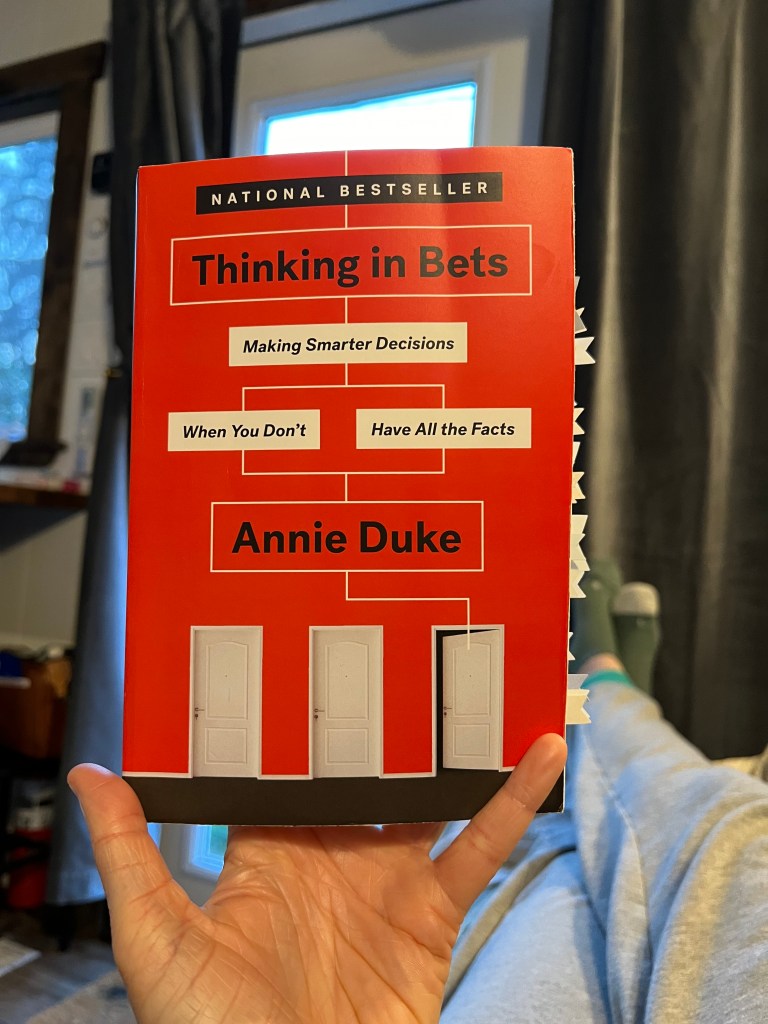
This is the first book of February’s “decision-making” theme. It’s been on my to-read list for a few years, and it bubbled up the list now because I have some high stakes medical decisions coming up and I wanted to take comfort in knowing that I’ve put in effort to be a good decision maker. What I came away with from this book is, however, mostly: I think I’m already an above-average decision maker. (In the spirit of the book, I’d put an 80% confidence level on that.) There wasn’t much that was new to me, but it was great to pick up citations I could later share on the way I approach decision-making already.
I have a heavy heart about how mixed my opinions are of this book. In the positives column, it lays out many important concepts people need to be familiar with if they want to become better decision makers. “Better” meaning you don’t necessarily always make the decision that leads to the best outcome, but rather over the long run you are making the types of decisions that will more frequently tend to get you good outcomes. The book does a good job of emphasizing the importance of perpetual practice to discern between skill and luck. (This is one of the main ways that poker differs from chess, for example. Poker—like life—involves luck, but chess almost entirely less so.)
But I found the reading very tedious at times. It was on page 23 that I first remarked to myself “where was the editor?” and sadly the needlessly repetitive writing continued throughout the whole book. So many examples of where, say, seven paragraphs could have been two. (I am naturally also a repetitive and verbose writer!, I get it! I’m hoping the practice of writing this newsletter can force me to improve that. But when writing a book, that’s what editors are for!) Also, while most of the ideas in the book are very sound, there were a few missteps that left a bad taste in my mouth, most notably the section on the importance of “diversity of thought” in groups, with no discussion of how that concept is often deeply misused in practice, to the utter detriment of the supposed goal of such an environment.
I think the most important learning I’m taking away from the book, however, are better ideas on how I can (and should) put my autistic-leaning decision practices away sometimes, to better read the room for when people are open (or not) to “truthseeking” chatter.
Rating: 2.5/5 – Two feels too harsh but three feels too generous. It’s the sort of book with important concepts that I would have been thrilled to recommend to others, but the actual reading is such a slog at times that I don’t think I will be recommending it. And I’m bummed about that.
Next week’s book: I’m rolling with a poker theme and reading “The Biggest Bluff” by Maria Konnikova.
French Study
I was so ill over the past two weeks that I only made one of my four French classes during that time. I also made the call to drop out of the music production class through Berklee Online that I had hoped to take this term. C’est la vie, I have to be able to roll with the punches with this illness. I do think I’ll be well enough to re-join my current French class next week though, and I’m excited for that.
My Year of Ne’er-do-well-ism
While so brain-fogged I could barely think last weekend, I started playing Stardew Valley for the first time. I’ve already clocked nearly 30 hours on my game; I’m having a blast with it. I really struggle with allowing my downtime to just be downtime, so I’m almost sort of proud of this fact.
As an example of how I often fail at letting my downtime be downtime, I also ordered this well-regarded anatomy coloring book! I needed some additional “too brain-fogged to do much” activities besides Stardew Valley. And, my physical therapist is often describing in detail what she’s doing as she works—which I deeply appreciate!—but I need to learn more of the words of things.
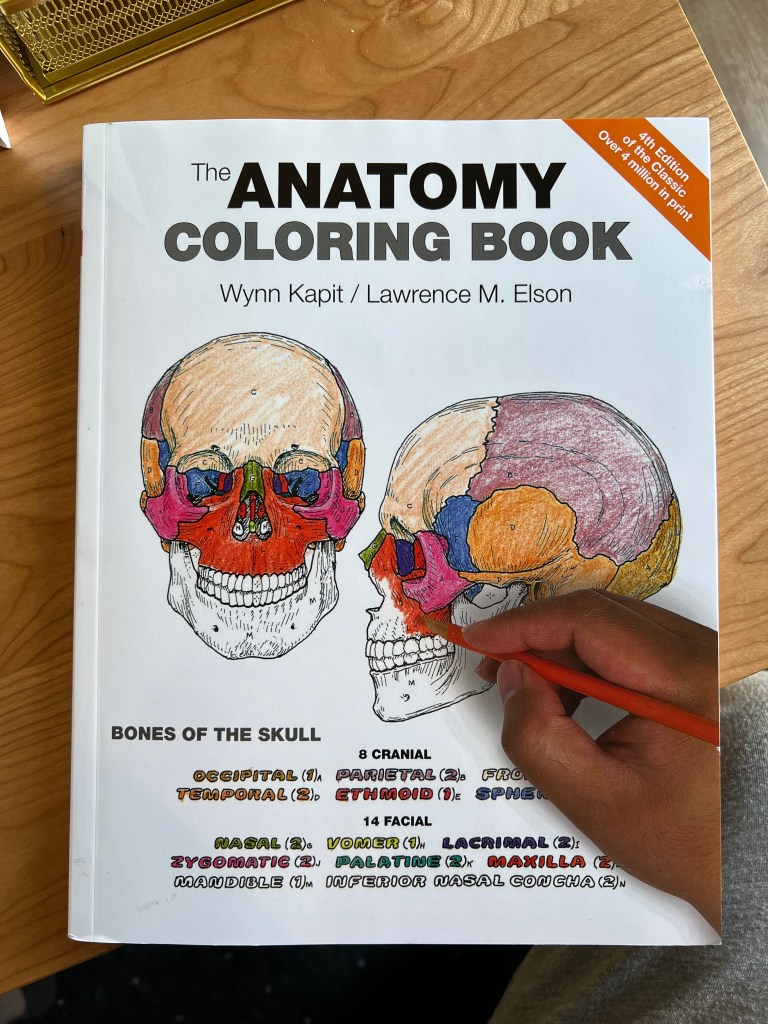
I’m hoping this section of my newsletter keeps me accountable for trying to find pleasant and decidedly unproductive things I can do even at my current level of illness. (It’s very easy for me to find “unproductive” things to do when I’m well; I live for sitting at an outdoor café, drinking and snacking and people-watching.) So I’m going to have to get creative given my current health. None of this sneaky “it’s a coloring book but also I’m studying anatomy” cheating. Real, true, anti-capitalist, enjoyable loafing around.
 Kate Violette