Time to read: 11 minutes
In this week’s newsletter:
The Timbit Times
Kate Film Club: technical difficulties
Book of the Week: “The Biggest Bluff”
A Brief Note About Kate and Rankings
French Study
My Year of Ne’er-do-well-ism
It’s been quite the week. I got news on a medium size setback (more on that under “The Timbit Times”), and continued to be worse than usual—but the setback perhaps explains the recent worsening. The part that continues to be frustrating, though, is how I continue to have to be my own lead doctor. I am incredibly lucky in that I now—after many years of getting sicker and sicker while doctors told me it was all in my head—have great doctors, the right sort of doctors. But because they all have their own individual specialities, patients with complex conditions are left to stitch together all their providers themselves. We have to email medical records around, the latest test results from one doctor must be sent to all others who may be interested in it (and there are a lot of tests), and even make our own treatment decisions.
There are a few different ways I could attempt to fix this current worsening I’m in, all of them plausible, and I’m frightened as fuck that I’m going to make the wrong call and make myself even worse, or, dead. I wish so much that doctors operated in teams, and that I could just have one big appointment with all my doctors, and listen to them bounce ideas off each other, and we could collaboratively emerge with the clearly optimal treatment plan. But instead it’s up to me to meet with each doctor individually and make my own call. I do have a main doctor!, who is extremely awesome, and he’s the one that I always make sure knows what all the other doctors are saying. But because we (= general American society/institutions) have historically spent shamefully little on research for infection-associated illnesses like Lyme, even my very excellent main doctor will often leave things up to me to decide, among a few approved options. And I don’t begrudge him for that!, if anything I appreciate it as a sign of respect that he knows I study my ass off on these illnesses and the latest research, as much as any doctor or researcher in the field. But it doesn’t stop me from wishing that it could all just be easier, if we built better systems for the reality of complex, infection-associated illnesses.
The Timbit Times
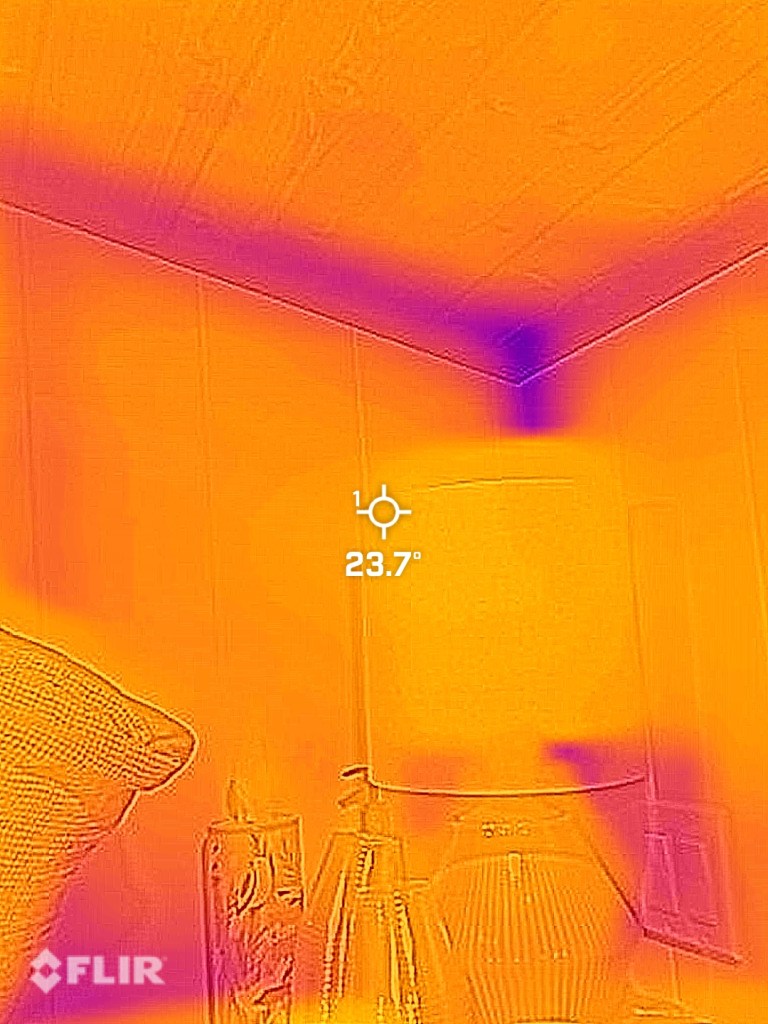
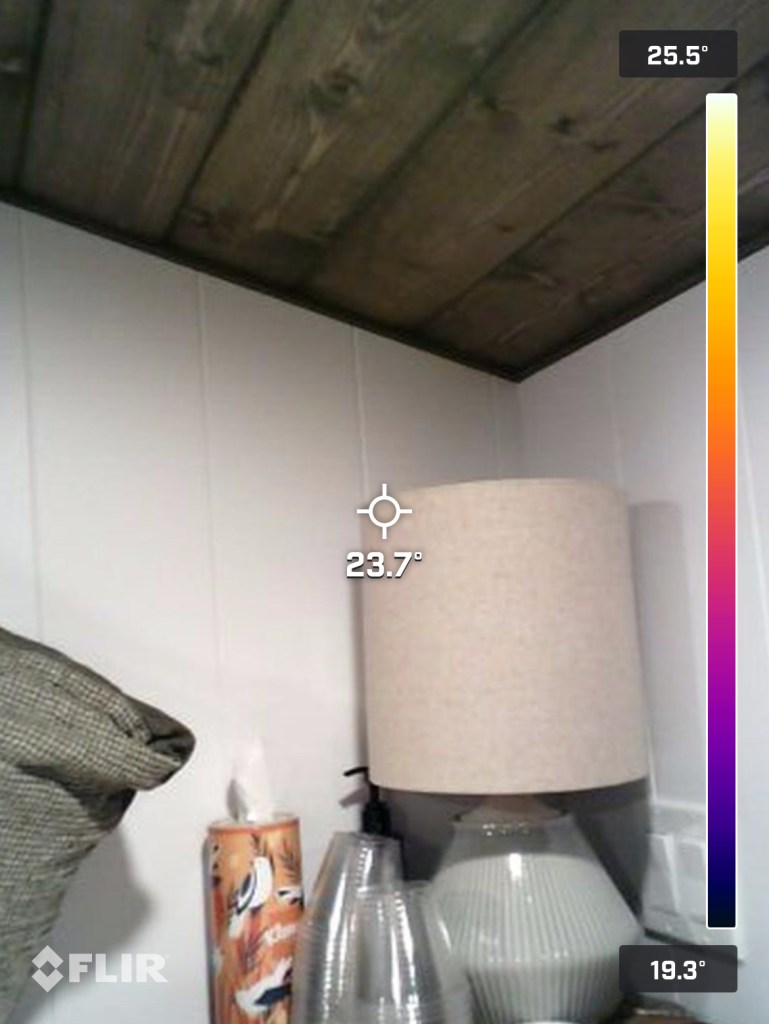
(Photos from a thermal imaging camera showing appropriate thermal differences along construction lines.)
So, the moderate setback is that an ERMI test I ran on Timbit—just out of an abundance of caution since I’ve been doing worse—came back elevated for only three molds, but unfortunately two of those are HERTSMI index molds and just the level of those two alone is too high for someone with my health issues. There is good news though: these two molds are considered “early” molds in that if there is a moisture issue, they show up first, since they require less moisture than some other molds. Furthermore, often these molds aren’t a sign of a water leak in the home at all, since they can even live on just regular household dust! So when I got these results back, I had to figure out if it’s coming from a problem in my own home, or if they’re just being blown in from elsewhere. The Pacific Northwest is a very moldy place, at least half of homes here have water damage, I’ve been told. It’s quite possible this could be blowing in from a neighbor for all I know, or even just the environment at large.
There are a number of things I’m doing in response to this, most notably getting better filters on my HRV plates—evidently, I’m just now finding out, they only came with MERV-3 filters (almost as bad as nothing) but there’s an option for MERV-13 filters (almost as good as HEPA) that I’m having installed next week. That’ll help with anything that’s getting pulled in from outside. And then for inside, I’ve gotten a proper HEPA air purifier that’s right-sized for my space, I’ve got hired help to deep clean my apartment soon (with EC3 spray), and I’m going to try out an ozone machine that I had purchased when I moved into Timbit but just haven’t gotten around to reading the manual for yet. I’ve also got some EC3 candles already handy that seem to be helping a little. The most fun part, though, is that I bought a swanky thermal imaging camera so that I could myself check for moisture issues in my home. And I’m happy to report that the problem does not appear to be due to a water or moisture issue in my home. So that’s at least something, and hopefully I can get this improved in short order. It was also just plain fun to get a new gadget to mess around with, that will help me take good care of my home in general.
Kate Film Club: Technical difficulties! Back next week!
I sat down to watch this week’s movie, which I had to get on DVD, and the first couple minutes seemed like…probably another movie entirely, but I stuck with it. Then the title sequence appeared and it was indeed, the wrong movie. The DVD was even labeled with the correct movie title!, so something must have gotten botched in manufacturing I guess. I didn’t want to hop out of chronological order, so I’m waiting on a replacement DVD and will do a movie double header next week. (Even if the replacement itself is still wrong, I’ve checked that there’s a copy at my local library and I’ll try that instead!)
Book of the Week:
“The Biggest Bluff”
(by Maria Konnikova, 2020)
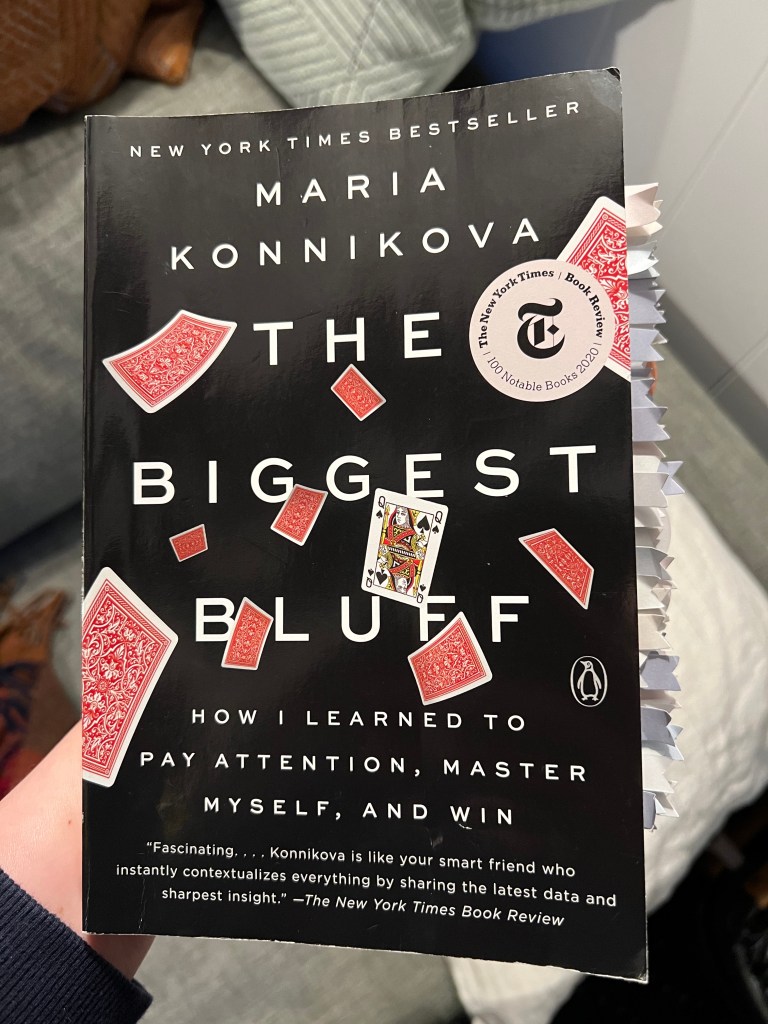
This week’s book is another account of a psychology PhD turned poker player. Last week’s author (Annie Duke, “Thinking in Bets”) took up the game as a way to maybe make a little cash while health issues interrupted her dissertation work, while this week’s author was drawn to poker as a way to explore: how can we know the difference between luck and skill, and how far can we tame luck through skill? Whereas “Thinking in Bets” was more of a dry (but useful!) accounting of cognitive biases and what are the habits and values that lead to good decision making processes regardless of outcome, “The Biggest Bluff” is much more focused on how to emotionally and psychologically train yourself to actually adhere to these known good decision-making ingredients. Practice vs theory. It also spends much more time illustrating these concepts through the story of the author’s personal journey, which makes for a fun adventure.
One thing I especially appreciated about this book, was how it explored just how unknowable the line between chance and skill is. Only in the long run can you really tell if a poker player is talented, or just lucky. And in contrast to poker, there is so much of life that we don’t get to run many hundreds, thousands, etc of times over. We don’t get to marry a hundred different people and see how it works out each time. We don’t get to simultaneously accept a thousand different jobs and see how we perform in each one. And so on. It also respects just how deeply we humans are wired to want to attach meaning to things. That to accept the full role chance plays in our life is incredibly emotionally and psychologically difficult. But it’s only by accepting it that we can learn to work with it, instead of sticking our heads in the sand or running away from it, choosing haplessness instead of “well, I’m going to do my best, and maybe my best can be a little better than I previously thought”. Staying centered, thinking through decisions deliberately, and then moving forward regardless of the outcome without beating yourself up for it—that’s life.
Rating: 3.5/5 – I might’ve been closer to a four here, if it weren’t for uncritical mentions of flawed thinkers (aka assholes) like Richard Dawkins. It’s a good book but I have a hard time trusting anyone who can mention, say, Niels Bohr without some sort of epithet like “Niels Bohr, famous physicist and noted asshole”. It always makes me worry I’m missing some other sort of flaw in the present speaker’s thinking. (This is not just a criticism of this book, this is a criticism I have of many books.)
A Brief Note About Kate and Rankings
A three and a half out of five is pretty good, actually. That’s me saying I would recommend a friend use one of their finite, lifetime book-reading slots to go read this book, if it sounds like a topic that interests them.
I’ve never understood how most people rate things ones or fives. This is—if you were unaware—why Netflix did away with star ratings and now only offers thumbs up or down, because of all the hooligans that eschew the middle of the scale! I want my ability to express nuanced options on television back!
I want the top of my scale to mean something. And so I reserve it for things that really move my soul. I’m a huge fan of classical music. A past boyfriend once refused to go to any further Oregon Symphony concerts with me, after one time when many people stood for a standing ovation and I remained seated. I was unmoved!, figuratively and literally. He said it was embarrassing to not stand when everyone else was standing. I said that to me a standing ovation is special, rare, and differences of opinion are never inherently embarrassing. (Before anyone asks: I was still clapping! It was a good performance! It was just not a “holy shit my soul is crying tears of joy” performance.)
So anyway, if you’re confused as to why I rate many things as middle of the road, it’s because: many things are middle of the road. That’s why it’s the middle of the road. There will be five out of fives sometimes though, I promise.
French Study
I signed up for the B1 DELF exam! Registration opened Monday for the March session. Whether I’m well enough to take a two-hour exam on a given day is a crapshoot with my current level of illness. However, the DELF runs only three times a year, and I’m hoping that if I sign up for all three, there will be one instance this year where I happen to be well enough on the right day for the exam. I was pre-emptively accepting I may be out the test fee once or twice due to needing to cancel same-day, but I wrote the adminstrators about it and they said if I register but am too sick for the March date, I could roll my registration fee over to the June date! (This test center doesn’t offer the December date, I think I’d have to travel to Seattle for that.) But I was thrilled and heartened by that reply.
The oral production portion of the DELF, sort of an interview, is scheduled individually and separately from the rest of the test, which is taken all together as a group. The adminstrator who fielded my request for accomodations said that for my oral production section they would schedule me later in the day since mornings are rougher with my symptoms. (The main test starts at noon, so I am good on that front, too.) It just was nice to have someone willing to work with an individual rather than say sorry we’re all cogs in a machine and there’s nothing we can do for you. Which happens a lot. But at least not today!
My Year of Ne’er-do-well-ism
I’m getting close to finding out what happens in Stardew Valley when you have platonic friends or flirty friends whose heart bars all fill up. (Nobody tell me! I want to be surprised!) High on the leaderboard of flirty friends we have: Leah the forager and artist, Harvey the doctor and ham radio enthusiast, and Emily the fashion nerd and part-time bartender. All very eligible suitors. I’m almost done my first “year” on the calendar, and my biggest income right now is making hella pickles and jams from all the produce I stockpiled in warmer months.
 Kate Violette