Time to read: 14 minutes
In this week’s newsletter:
The Timbit Times
Kate Film Club, 30 of 52: “The Rainmaker”
Book of the Week: “The Incandescent”
French Study
What Gets Measured Gets Done
I didn’t expect I’d be unable to return to writing a weekly newsletter for the whole first half of 2025 (and then some), but, sometimes life comes at you hard. I spent mid-December through early March staying with a friend in Michigan, to have a bit of supervision while my doctors and I geared up to finally start treating my Lyme disease. (I’ve been diagnosed with Bartonella and Babesia as well, the unholy trifecta.) I improved a bit while in Michigan but I continued to be sufficiently sick enough that it still took until I was back in Oregon for us to have gotten my body to a place where I could begin to withstand antimicrobial treatment for the baddies mentioned above.
I was lucky enough to begin work with a local Lyme-literate specialist once back here in Oregon. The parallels between managing my medical care and my experience as a software engineering manager continue to jump out to me, such as how to know when you need a generalist for a particular task, or a specialist. My main doctor continues to be excellent as a complex illness generalist because I’ve developed so many more medical issues than just a Lyme infection in the many years that I was dismissed by doctors. I need someone that can hold all the pieces together in their head. At the same time, successfully treating Lyme disease itself is highly nuanced and nonlinear and individual. There are no established one-size-fits-all treatment courses in the medical literature, and therefore treatment decisions must be made based on clinical discretion. It helps, then, to work with someone who does nothing but treat Lyme patients every day all day long.
I’ve had two big successes in working with this new Lyme specialist in the past few months. If you’re interested in following along in more detail, I’ll be posting more of the detailed play-by-play on my “health log” Bluesky account. The gist is I’m still quite sick, but I’m able to move around my apartment a bit better. I have, however, begun sleeping kind of ridiculous amounts. I’ve heard from other folks who’ve recovered from Lyme disease that when their doctors hit on treatments that were really going to move the needle positively for them, they started sleeping like 12-13 hours a night, sometimes for several weeks. So, here’s hoping the sleep thing is good news and means we’re on the right track.
The main thing I’ve been thinking about—as I have a smidge more energy to, you know, think—is how to try to keep in touch with friends again. The first half of 2025 had some difficult social conflicts and heartbreak for me. I’ve withdrawn from most people I know, and have only been keeping up with a couple or so friends. Even then, I haven’t been keeping in touch entirely reliably. I think there are several barriers to keeping up with folks more who I’d very much like to keep up with, and one part of it is: I don’t want to have to repeat my depressing current life story over and over to everyone. It gets tiring having to play press secretary for my ill self. You may say, “but Kate!, you don’t have to explain everything to everyone just to be friends”—but trust me, I really do.
I’m increasingly at a stage in my illness where I may have brief good patches followed by much worse ones again. Meaning, I might have a burst of being able to keep up with friends and then suddenly not be able to for a while. I don’t want to be seen as flaky; I want to be accurately seen for who I am in the particular situation I’m in. I want people to understand, just how fucking sick I am and in what ways, so that my limited social energy can be spent on connecting with people, rather than having to defend my case and explain my limitations over and over again in an attempt to receive right-sized understanding and grace. I want to say hi to more people more often, but I need people who can hang with someone who’s gonna be like a staticky radio station for a while, passing in and out of signal legibility. Hopefully it won’t always be like that, but that’s what I have on offer at the moment.
I also only want to connect with people who can indeed handle talking about illness, who don’t shy away from the difficult stuff of life. I’m just not someone who can exclusively do surface-level right now. (I also can’t stay in the depths all the time—it’s so boring and disheartening down here.) I need a combo of surface and depth. I don’t want to talk about being sick all the time, and I also can’t pretend my illness doesn’t exist and bleed into every area of my life. So anyway, I’m going to try to start saying hi to people again—slowly, as I have energy to add more folks on my keeping in regular contact rotation—and sending them this newsletter. This will be a good place to keep up with what’s happening with me. Please feel free to ask me about it!, I’ll probably want to discuss it, I just need to not have to repeat the basic update details to everybody all the time.
I also…am just very tired of being alone. I’m alone almost all of the time. Just me, in my bed, chillin’ silently. Talking to other people is hard because I don’t think many people understand what it’s like to live like this for so long. People talk about how difficult “lockdown” was for a few months in the early pandemic and like…that’s been my life for 5 years now. I’ve been forgotten about and discarded, to an overwhelming degree. It’s hard, when your energy is so limited and you can barely care for yourself, to convince yourself to make conversation with others when you (not entirely unreasonably) fear they’ll probably ditch you at some point, too. For a very long time, I really needed all of my energy for daily survival, and now that I maybe have a single digit percentage amount of energy that I can devote to fun, I’m still left thinking: Who has time for niceties when they’re fighting for their life?
People just have no idea, no idea, how bad an illness can be without you being dead yet. (If they did, they’d all still be masking in public while we wait for better preventions and treatments for acute and Long COVID.) I kind of just don’t know anymore how to talk to anyone who hasn’t experienced something like this. I’d like to figure it out, but I’m…still figuring it out.
Anyway, with that unusually long intro out of the way, let’s head into the usual sections. It gets more fun from here. C’est parti!
The Timbit Times
This will be a very short section today, because—I’ve made the decision to sell Timbit! I absolutely loved my year living in a tiny home, and would highly recommend it. As for why I made the decision to move back into a regular apartment upon my return to Oregon earlier this year, that’s a longer story I’ll save for another time. I’d like to write a recap of sorts of what I learned during my time with Timbit so I’ll put the story there. I should have a sales flyer of sorts made up in the next week or two, so if you’ve enjoyed my Timbit tales and are looking to buy a tiny house of your own, I’d love to hear from you.
Kate Film Club, 30 of 52: “The Rainmaker” (1956)
I should’ve put more stock in it when I saw on the Apple TV detail page that this movie got 80% on Rotten Tomatoes. In my defense it was billed as a “western romance” and I have a bit of a thing against westerns. All I can think about when watching westerns is “these people think they’re so tough and cool but they’re living on violently stolen land, the antithesis of cool”. I can’t seem to manage whatever suspension of historical awareness is necessary to be someone who enjoys westerns. I’m real fun at parties.
Anyway, the extent to which this movie is a “western” is that it takes place in the southwest amid a long-running drought. There are some cowboy hats, I suppose. There are barely even any horses. Most of the movie takes place in a single farmhouse and the exterior milieu is unimportant—other than the drought, the drought is very important to the story. The other “western” elements are just stylistic window-dressing.
As for what this movie actually is?, well. This movie is a dizzying foray into the question of: what’s the difference between having faith and getting conned? Between having dreams, and actively fooling yourself and those around you? What’s the difference between love and a con?, not just romantic love, but familial love too? In what ways do we knowingly allow ourselves to be conned because it’s preferable to the alternative? Perhaps fun, even? And if we’re a semi-knowing participant in our own conning—is it really still a con? Or does the act of knowing participation alchemize it into something else entirely? Can you create truths from bullshit?
One thing I like to do as I work my way through Katharine Hepburn’s movies is to write down quotes that particularly stick with me, to either try to sum up the movie or just to share a good quip. I probably wrote down more quotes from his movie from almost any others of hers that I’ve watched so far. “The Rainmaker” is a whirling epistemological tornado, a supposed western romance that cruises at the altitude of a Greek tragicomedy. The acting is also superb—more than one Hepburn monologue moved me to tears, while Burt Lancaster is delightfully unhinged throughout. (My first introduction to him, I’d be happy to see more of him in the future!)
I could go on and on but I’ll just stop here and tell you that you really should watch this movie. If you, like me, have a brain that likes to chew on philosophical puzzles and existential questions, you will absolutely love this movie.
Rating: A coveted 4.5/5 stars on the Kate scale!
Where to watch: Streaming on Apple TV and Amazon.
Quote: “You’re all dreams. And it’s no good to live in your dreams.” “It’s no good to live outside them.” “Somewhere in between the two?”
Book of the Week: “The Incandescent”
(by Emily Tesh, 2025)
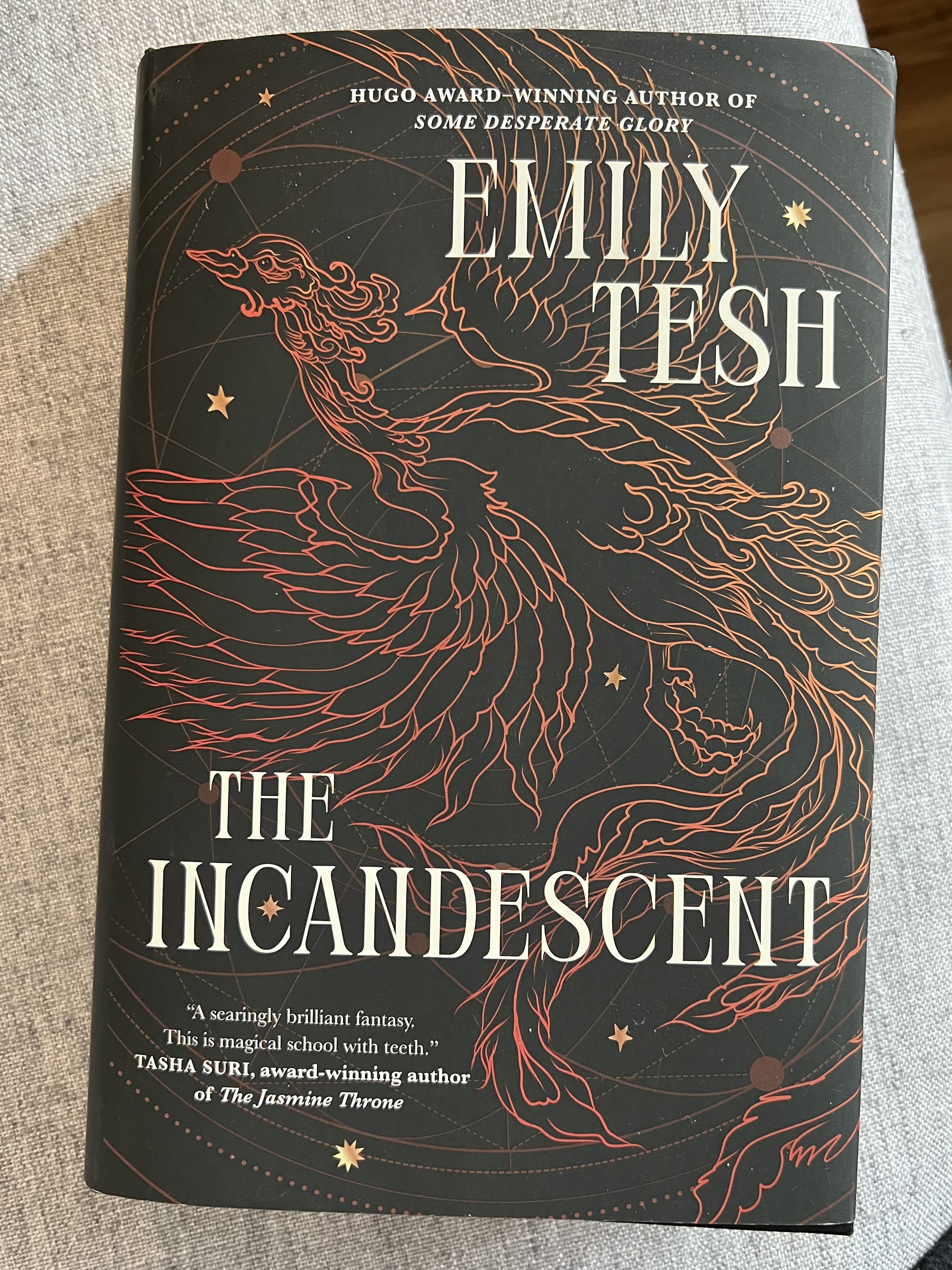
This newsletter is already on the longer-than-usual side so I’ll keep my review short and sweet. This is like an adult version of magical boarding school, and by “adult” I mean more “tiresome workplace politics” than sexy. If you’re a 40-something millennial who loves a pretty realistic queer romance and can’t say no to a good demon hunter story, then this book is for you.
One of the things that drew me into this book was the pitch perfect calibration of how much the magic in it gets explained and described. There’s just enough explanation to make it interesting, and to draw you into the world and to make it feel real, but not so much explanation that it drags the story down. I really liked the bit about how demons gain power by effectively eating things like purpose, meaning, consciousness, because demons have none of these things but hunger for them. (There’s probably a whole metaphor to be explored here about how the demons of our lesser judgements or internal criticisms also expand when we give them an “I”.)
Without spoiling much, I’ll add that the bit in the second half of the book where a human gets possessed by a demon, and the story is told for a while from the demon’s point of view, was one of my favorite parts of the book. Watching a creature not used to having a physical form rue the limits of a physical form—but also marvel at its upsides—really resonated with me, as a person who is forced to spend more time than they’d like thinking about their physical form. A demon frustratedly discovering that one’s meat vehicle won’t just go to sleep when you want it to if you have feelings getting in the way is a whole mood.
Rating: 4/5 – A really fun read, I highly recommend it. Warning: it can be very hard to put down—I had to stop reading it at night because it kept tempting me to blow past my bedtime. Oops.
French Study
One morning habit I’ve recently picked back up is watching a half hour or so of Télématin every morning over breakfast. (Think like the TODAY show, but French.) I went through a multi-month patch of not being well enough to take any French classes, even informal conversation ones, and my aural comprehension really suffered as a result. It’s wild how quickly it’s returned though—I suddenly started picking up more lyrics, without even trying, from the Clair Obscur: Expedition 33 soundtrack. Brains are wild. Language learning thrives on frequent repetition.
What Gets Measured Gets Done
One thing I realized in conversation recently is that part of what was so motivating to me back in my pre-illness fitness nerd days was watching numbers change: body composition percentages, limb diameters (to track muscle size), etc. I don’t know if that’s an everybody thing, or a me being a math nerd thing, but I realized I needed something similar for carrying me through my illness. I’ve been thinking on what numbers I might try to track to drive optimal decision-making at this stage of my illness (and/or possible recovery), and a lot of it has to do with making sure my body is getting enough rest. Especially, is my nervous system getting enough rest?
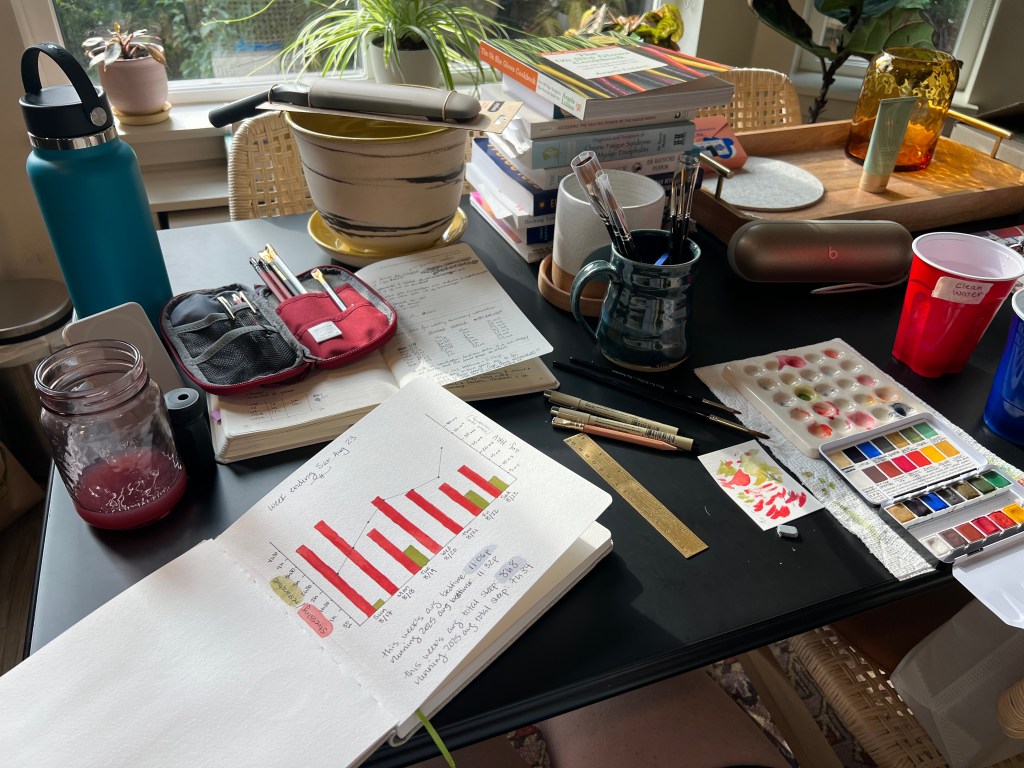
I also wanted there to be something…ritualistic about how I review my stats each week. So I dug out my watercolors and made a graph by hand. I had so much fun doing this. I know that like, sort of the point of watercolors is to be free in your painting. But I had a blast painting something with a concrete mathematical aim. This may become a habit.
I’ve graphed the daytime hours of “Stressed” vs “Restored” time from my Oura ring data, as well as my average nocturnal HRV (heart rate variability) the ensuing night. I’m curious to see, if I do a better job of reducing the time my body is being stressed, and increasing the time my body is catching restorative time during the day, does that show up in a calmer nervous system at night? The first thing I’ve found is that it’s actually kinda difficult to get my body all the way down into what Oura considers the “Restored” zone—a 90 minute massage will always do it, meditation will often do it…and that’s all I’ve found so far. Anything done lying down will reduce the amount of stress my body is under, but lying down while doing something mentally active doesn’t necessarily get me relaxed enough to quality as “Restored”.

Someday maybe I’ll be lucky enough to start tracking my steps. Until then, it’s a focus on rest and recovery. My average bedtime this past week was 11:06p and my average total sleep was 8 hours 8 minutes. I think I can do even better than that this upcoming week.
 Kate Violette