Time to read: 13 minutes.
In this week’s newsletter:
Kate Film Club, 31 of 52: “The Iron Petticoat” (1956)
Kate Film Club, 32 of 52: “Desk Set” (1957)
Book of the Week: “How to Be Enough”
French Study
Things I Read on the Internet This Week
Am I the only one who gets bummed when they try to start a new routine, or revive an old one, and you don’t manage to stick with it perfectly right away? I ask this full well knowing I’m not the only one. Yet, I seem to have been hard-wired with a bad case of it: when I was a young kid learning to play the piano, if I couldn’t get a piece perfectly on the first try, I’d sit there and cry over the keys. (Somehow I snapped out of this within the first year or two and developed a lifelong love for the piano—proof that even rocky starts can later become solid.)
Why is it so hard for many of us to truly feel successful even in partial success? Partial success is still better than nothing! You’d think being big sick for 5 years now would have given me some wisdom around this. But truth be told while there are ways my illness has certainly made me more wise, there are also ways it’s made me more impatient and unforgiving. I don’t like this, it’s just the nature of the experience, I think. One thing I’ve promised myself is: I’m never going to beat myself up for failing to be the perfect patient, to have stumbled at times from the platonic ideal of a sick person who can bear all things with unflinching grace. I aspire to that, and I will never quite reach it no matter how I try, and I (same as anyone in this position) have to find a way to be ok with that.
All this to say: I really hoped after my first weekly update in a while back in August, that I’d be able to jump right to doing them weekly again. But I had a couple of rougher weeks—not backsliding in my overall illness, but some side effects gone wild of an important treatment I was on that took my doctor and I a bit of time to figure out. I’m doing a bit better now (hence the energy to write!), and I’m trying to celebrate that, despite knowing I’m so far from being out of the illness woods that my recent skipped newsletter weeks certainly won’t be the last missed ones, before I’m back to a health level where I really can write my newsletter every week.
With that said, let’s do the thing. I’ve got two Katharine Hepburn movie reviews for you, a book review, ongoing language learning news, and a new section I’m trying out regarding things I read on the internet this week. Let me know what you think of it!
Kate Film Club, 31 of 52: “The Iron Petticoat” (1956)
I watched this some weeks ago and I cannot find my notes on it! However, I think I can still remember enough to give this about the same review I would’ve given it with my notes, because I was very underwhelmed by this movie.
The gist is Katharine Hepburn plays a Russian military pilot who flies into West Germany, less for reasons of flying to West Germany, and more simply away from Russia, where she’s recently been passed over for a promotion in favor of a less-qualified man. (Tale as old as time, girl.) Bob Hope is a US officer who’s about to go on leave but instead is ordered to try to persuade Hepburn’s character to officially defect from Russia. What follows is a bit of a slapdash comedy where each character is somewhat convincing the other of the upsides of their particular culture, with the two eventually falling in love—unconvincingly I might add, as this pair of actors really didn’t have screen chemistry at all.
This movie was a solid flop for me. It was rather jingoistic, and I could happily go the rest of my life without ever again watching Hepburn imitate someone of another nationality. (I’m getting flashbacks to “Dragon Seed” here even though this movie wasn’t quite as bad as that one.)
Rating: 1/5 – Eminently skippable.
Where to watch: As far as I can tell, the only place to find it is on YouTube. This may be because Bob Hope worked to suppress the movie after its original theatrical run. Ironic, because if the Wikipedia article is to be believed, Hope is the main reason the movie was so terrible—he took what wasn’t exactly supposed to be a comedy and had his writers hammer gags upon gags into it, effectively rewrote Hepburn’s character, and removed many of her best scenes. This movie should be a lesson everywhere to managers of teams with one “star” employee who makes life hell for everyone else: the product will never be as good with him as it would have been without him.
Quote: (No quote this time since I can’t find my notes! You’re not missing out on much.)
Kate Film Club, 32 of 52: “Desk Set” (1957)
In contrast to the previous movie, “Desk Set” is a spectacular film. It’s fascinating to see the same themes playing out in a movie from the 1950s as we’re still grappling with today: fear around technology replacing people in the workplace and making our world less human, and the proponents of said technology grossly over-promising what it can really do.
“Desk Set” focuses on the reference library department of a (fictional) major broadcasting network. Hepburn’s character (Bunny) is the lead of a small team that has the familiar jovial banter of a group that’s worked together for a long time. One day Spencer Tracy’s character (Richard) comes in to begin taking measurements around the department without explaining why. Eventually it leaks out that a supercomputer is going to be installed in the department, that can replace much of what the current team does. Panic and resentment ensue.
In the lead-up to the machine being installed, it’s clear that Richard is developing a soft spot for Bunny. He’s impressed with the scale of knowledge each woman on the team has, and in particular Bunny’s nerdy capacities. (In modern parlance I’d go so far as to say that Bunny is perhaps a bit neurodivergently coded.) Eventually, it appears the feelings are beginning to be returned—there’s an endearing Christmas party scene where the whole office gets drunk (ah the 1950s) and Bunny and Richard share probably the steamiest look I’ve ever seen two fully-clothed people exchange. That scene alone is worth the price of admission. We don’t show romantic longing like that in movies anymore—I wish we did! It’s powerful!
However, when the supercomputer finally arrives, it’s not clear if there’s going to be a happily ever after or not. I won’t spoil the ending for you!, but I will give you a clue in the form of a fun fact. The screenplay for “Desk Set” was written by Phoebe and Henry Ephron—Nora Ephron’s parents! It was adapted from a 1955 play by William Marchant. The movie certainly has Ephron vibes (complimentary)!
Rating: 5/5 – There’s just so much to love in this movie, and to think about. It’s pitch perfect the whole way through, no notes.
Where to watch: Streaming on Apple or Amazon.
Quote: “I’ll bet you write wonderful letters.”
Book of the Week: “How to Be Enough”
(by Ellen Hendriksen, 2025)
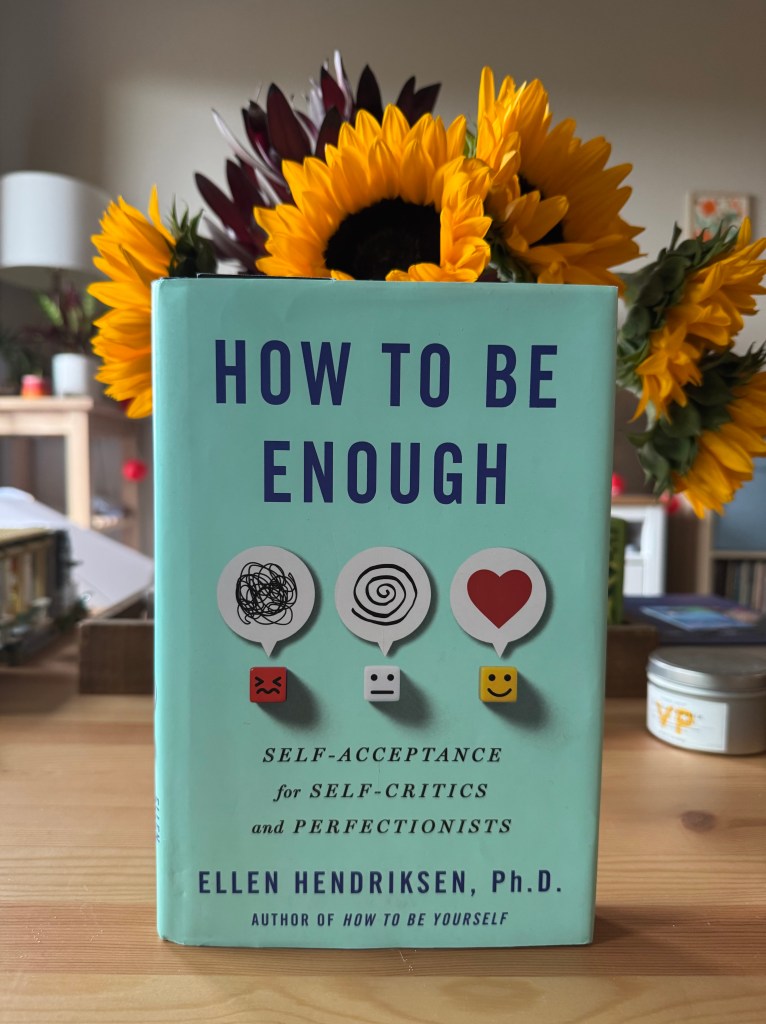
Having spent a good chunk of my career thus far as an engineering manager, I’ve spent a lot of time thinking about behavioral psychology type topics. One of the themes I think a lot about is audience-message match (or mismatch). What I mean by this is: it’s not very helpful to tell someone who’s already arrogant about the importance of confidence. Similarly, it’s not helpful to remind someone already prone to selling themselves short of the importance of humility. Confidence and humility are generally universal values!, but not every person needs to hear every message, and in fact some audience-message mismatches can be harmful. This is a long way of introducing this book and explaining what I view as its intended audience, which is: people who struggle with perfectionism or excessive inner or outer criticism. If that’s not you, you probably won’t find much in this book to be of news to you; but if you, like me, are much too hard on yourself sometimes, read on.
The author sold me on the book near the beginning when she reassured the reader that we’re not going to “lower our standards”, that we’ll still be high achievers and most importantly we’ll still be ourselves. But the subtle mental reframings offered in the book can be highly impactful and freeing once you start to notice all the places in your life where they might be useful. Some of the chapters detailed work I’d already done for myself previously in life, and tools I’ve long since become adept at using. Other chapters contained some ideas that were rather new to me! I imagine any sort of deep thinking person will likely have a similar experience with the book: you’ll have some opportunities to pat yourself on the back for a job already well done, as well as some helpful new tools to take for a spin sometime. The main thesis of the book is: having high standards isn’t bad in itself, it’s how you handle being a person with high standards that can make or break the enjoyment of life, for you and those around you.
In the cons column: a couple of the visualizations and exercises didn’t really land with me. But as always with self-help books: take what resonates and leave the rest. Not everything is going to be for everyone. And overall, her style of humor grated on me in certain places—although in other places, I found her funny. These drawbacks are not critical failures though, and I’d still heartily recommend this book to anyone who struggles with being too hard on themself.
Rating: 3.5/5 – A bit better than your average self-help book. Worth the read.
French Study
I finished Clair Obscur: Expédition 33, in French! I actually finished it during the summer but just hadn’t gotten around to writing about it yet. This is the first time I’ve played through an entire video game in French, and it felt meaningful to do so for a game that was made by a French team. This is one of the things I love about learning other languages: you can experience art in the language of the people creating it, directly, without an intermediary translating the experience for you. I do appreciate they left in the French swears even in the English version of the game though!, ha. (I caught bits here and there watching a friend play through the English version.) Esquive, parade (a faux ami!), dégâts are all words now permanently in my French vocabulary.
Anyway, as for the game itself: it’s spectacular, and largely it’s one of my favorite video games I’ve ever played. My one complaint is I really didn’t like the plot twist between Act II and Act III. It wasn’t exactly “someone woke up and tee hee the entire story up til now has been a dream!”, but it was that sort of flavor, and it soured the plot for me. Still though, the game is visually gorgeous, the fight mechanics are super fun (Lune is my favorite—I love making advantageous chains of elemental specialties), and I still love the characters even though I feel like the plot let me down after a certain point. I’m very interested to see what this development team comes up with next!
Things I Read on the Internet This Week
Being still stuck at home these days for the most part means I read a lot on the internet. My intention here isn’t to share a firehose of everything I read on the internet in a given week (that would be a lot), but rather some cream of the crop picks that even folks with less time to sit and read might find worth their limited time. Sometimes I’ll also include links to older related articles I’ve read that are also likely worth your time!
“Butt breathing” might soon be a real medical treatment
One of those at first seemingly outlandish ideas that once you read about it, actually doesn’t sound that weird at all. Reminds me of another article I read last year about another newish form of emergency cardiopulmonary support, although this one already being used in practice in a few locales across the world.
The Race to Reinvent CPR (non-paywalled version)
This is that older article. I like stories about how we as a species are always working towards helping each other live longer lives. We need more of that in general.
American politics has devolved into shitposting and aura farming
One of the most brilliant pieces of political commentary I’ve read in a long time. It also helped me understand my conflicted feelings towards shitposting—I mostly don’t like it because I feel like it’s a cheap way out from the vulnerability (and utility!) of earnestness…but I’ve also sensed that in some specific ways and contexts, shitposting can have its own utility. Now I’ve got a framework that expresses exactly that and makes it all make sense.
‘I’m suddenly so angry!’ My strange, unnerving week with an AI ‘friend’
The main thing I can’t get over when it comes to the whole idea of AI “friends” is: who wants a friend that just agrees with you all the time? I don’t think that’s much fun—how are you ever going to learn anything or grow? How can you ever trust that you’re really hearing that person’s inner thoughts, that you really know them as a person, that you’re establishing meaningful bidirectional emotional intimacy? Of course, an AI has none of these things: inner thoughts, personhood, emotional depth. The pull quote that sums it all up: “This is the first of many times during our week together when I feel as if I’ve become trapped talking to the most boring person at a party.” Sounds about right.
Why are so many straight guys so bad at gossiping? (non-paywalled)
Also, this reminds me of another article I read some time ago, which is another thing an AI can’t do: dish some quality “neutral gossip”. I love neutral gossip with the enthusiasm that beams from that Marie Kondo “I love mess” gif. AI could never.
 Kate Violette