Time to read: 13 minutes
In this week’s newsletter:
2026 Goals Check-in
Kate Film Club, 34 of 52: “Long Day’s Journey Into Night” (1962)
French Study
I had an interesting discovery about l-glutamine back in March. For a long time, I’d been taking about 2.5g l-glutamine daily for energy production reasons. [1] It really helps shorten PEM crashes when I’m in one, and seems to help prevent them, too. For some reason, I stopped taking it back in January—maybe I was trying to see if I could go off of it yet? Don’t be like me kids, remember to take notes not just on when you start/stop medications or supplements, but also why! Anyway, by early March I’d decided to add it back in, and when I did, I got a weird nocturnal symptom that I only get with two other things: melatonin—back when I was slowly increasing my dose to a “cruising altitude” of 5g nightly (which is now fine), and glutathione.
The symptom is very specific: I call it a “power surge” in my muscles. It’s like too much electricity (or something) is trying to be pushed through them, and the only way to relieve this distressing feeling is by voluntarily shaking my limbs non-stop. It’s usually worst in my legs, especially the big muscles of the thighs, but sometimes I get it in my arms too. Since it seems to perhaps directly be caused by taking exogenous glutathione, a while back I’d done a little reading to see if melatonin happens to increase glutathione production. There are a few exceptions in the literature [2] but generally the answer seems to be that yes, taking melatonin stimulates glutathione activity, at least in mice [3], rats [4], chicks [5], human and rat erythrocytes in vitro [6], and in two species of sage [7]. Yes sage!, the plant! I was not expecting to find an article about oxidative stress and management thereof in plants, never mind discover how similar those systems are to that of humans (the article also discusses catalase, peroxidase, superoxide dismutase, etc). We share more in common with the plant kingdom than you think. Did you know we share 30% of our DNA with lettuce?! [8] I learned this a few months ago and have been entirely fucked up by this knowledge ever since. Every time I eat a salad I’m like hello, my distant cousin! I digress.
Since l-glutamine powder was now giving me this same weird “power surge” symptom, that was previously specific only to melatonin and glutathione, I decided to see if it was implicated in glutathione production somehow. Turns out l-glutamine is actually one of the building blocks for glutathione. Mystery solved. My hope was that, since I apparently was fixing a deficiency in l-glutamine (per my body’s individual demand), glutathione production was ramping up but would plateau once my l-glutamine stores were replenished. And hopefully then the power surge symptom would go away again. That’s exactly what happened, and it only took maybe 3-4 days.
I should add here, in case anyone with a similar illness reads this and decides to go out and try l-glutamine for energy or glutathione support: in a lot of folks with ME/CFS or ME/CFS-like illnesses, l-glutamine gets turned into excess glutamate in the brain, which can be over-stimulating and cause restlessness, anxiety, and other unpleasant neuro symptoms. I’m in the minority that appear to process it well for some reason, but even I seem to do best with no more than 2.5g per day. So until you know how you personally do with it, make sure to “start low and go slow” if you do experiment. I was trying a different brand recently, and the scoop was differently sized, so I ended up trying 3.5g daily for a while, and that was definitely too much for me.
So anyway, today’s intro has been a long way of saying: it’s important to form and test (by experimenting) or check (by perusing the literature) your own hypothesis about what specific supplements might be doing in your unique body. And if you happen to be looking to support glutathione production, maybe consider if you’re getting the right amount of l-glutamine for you in your diet and/or supplementation.
2026 Goals Check-in
Oo, a new newsletter section! Shiny!
At the beginning of 2026, I spent time thinking on goals and habits the same as I do every year. One thing I need to focus on this year is pulling my bedtime earlier again—I do so much better during the day if I’m asleep before 11p. I’ve been using an Oura ring for about five and a half years now, so I’ve got a lot of data to look back on!
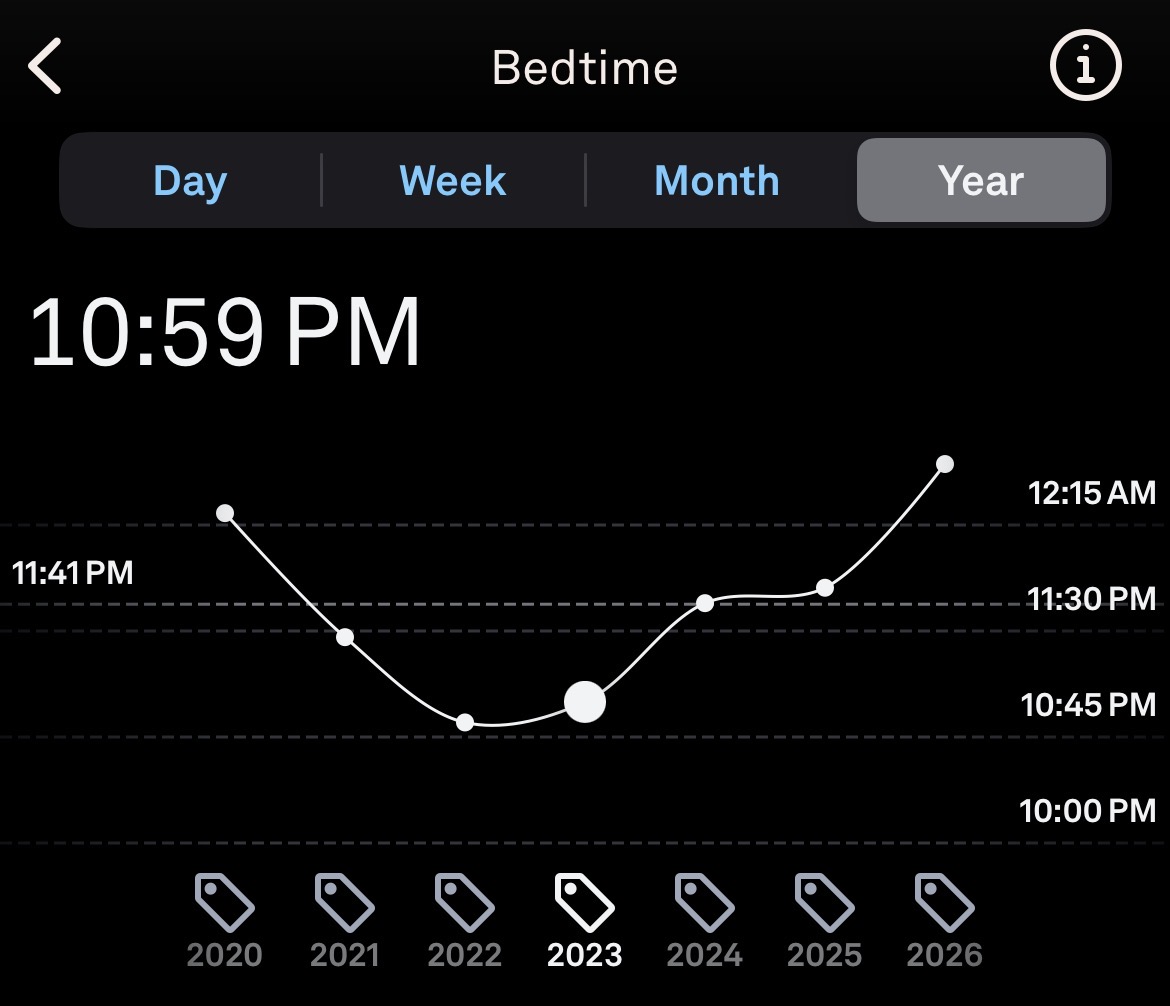
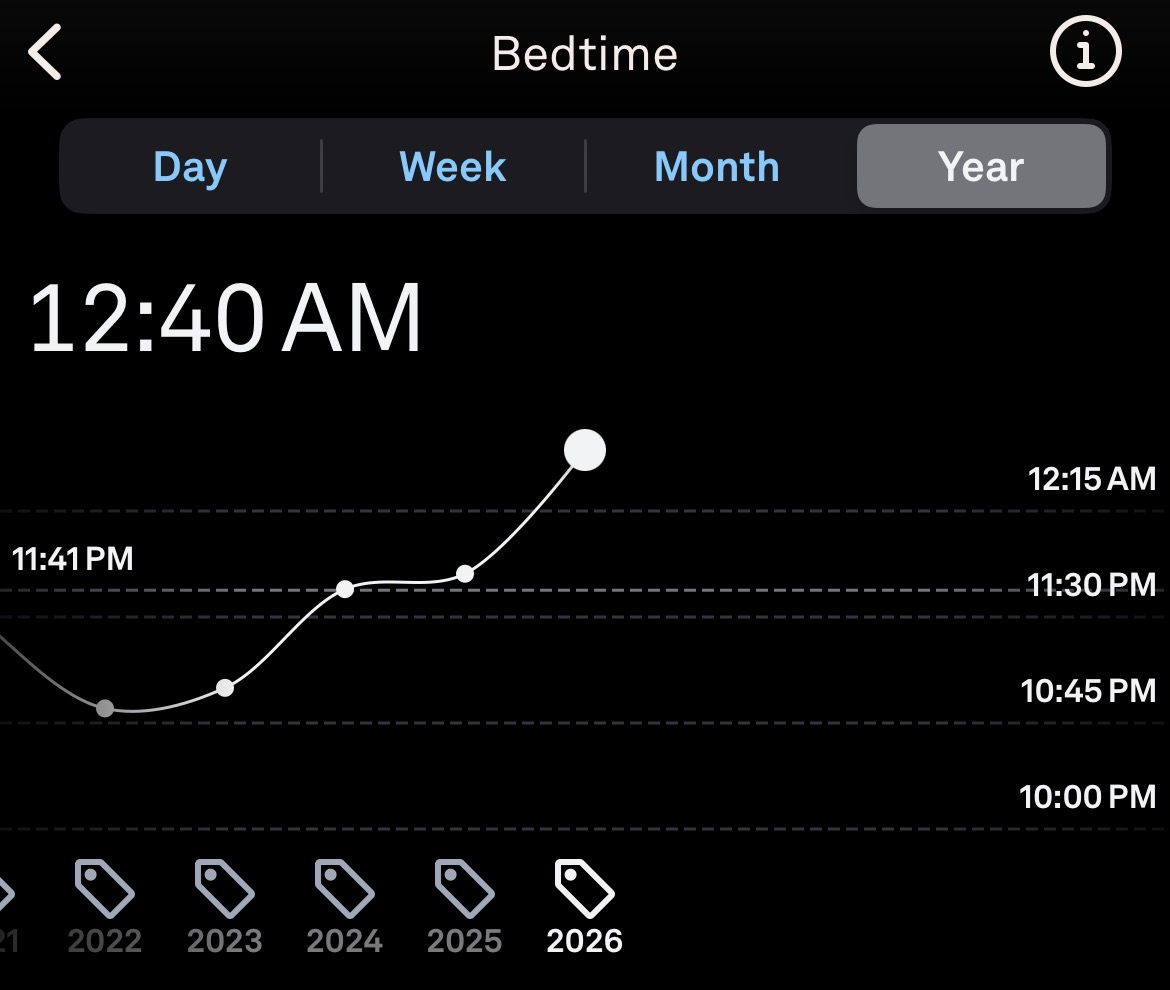
My goal is to get back to the banner years of 2022-2023, where my average sleep time was indeed prior to 11p. So far this year my average is well past midnight, clocking in at 12:40a. I’m putting this here because announcing to your friends that you’re gonna do a thing makes you much more likely to actually do the thing. Stay tuned.
Kate Film Club, 34 of 52:
“Long Day’s Journey Into Night” (1962)
Few movies have ever been as appropriately titled as this one—a “Long Day’s Journey Into Night” was indeed an almost three-hour, very long journey into night. Part-way through I spontaneously thought of the “it’s been 84 years” meme, paused to see how much I had left, and to my dismay I discovered I was only half-way though. This movie has a mind-blowing 95% on Rotten Tomatoes, so I guess this is just a me thing, but personally my idea of a good time doesn’t involve watching a heart-wrenching yet also monotonous 3 hour fight among various members of a dysfunctional family, bitterly addled with substance abuse and other issues.
One thing I thought a lot about during this movie was the difference between reporting and art: what makes the difference between simply reporting or re-enacting events and making art from them? You can pick up on the movie’s main schtick pretty quickly: the characters are going to be locked in cycles of saying nice things then mean, mean things than nice, the whole way through. No one is spared from either end of launching or being hit by these oscillations. It was predictable and boring, and it didn’t feel like this reporting of events ever got up-cycled into art. Many of the best lines of this movie were actually quotes of other works! A notable exception to all this is when Katharine Hepburn’s character suddenly and animatedly exclaims over lunch, “I HATE DOCTORS!”. Same girl, same. I feel that sentiment, and I appreciate somebody keeping it interesting for once in this film.
I suppose I haven’t even told you what this movie is about yet. It’s an autobiographical account of Eugene O’Neill’s family dysfunction shortly after his first marriage fell apart and right before he was sent to a sanitorium for tuberculosis. Ostensibly, and in many of the synopses you might find on the internet, you’ll hear that it’s a tale of a family in the throes of a mother with an opioid addiction. But that’s an oblivious, sexist take. Every man in the family (the father and two sons) apparently has a drinking problem—their own substance abuse issues. The older brother has no ambition and spends what little money he has on booze and prostitutes. The father is roundly described as a cheapskate who terrorizes the family over so much as having more than one lightbulb on at a time. The younger brother gets off easy in the eyes of the script (as you might expect for the writer’s self-representation), but still isn’t without his own more mundane faults. But the one thing that none of these chauvinistic men seem to consider is how the mother’s extreme social isolation contributes to her difficulties in trying to stay on the wagon and fight her addiction. She repeatedly talks about this!, but nobody listens. They just expect her to magically stop using with zero external support. Ok, sure bro. Maybe listen to women for once in your life and y’all could actually work on healing your family. Or not. You do you I guess.
The best thing I can say for this movie is: a lot of other people really seem to like it? Hepburn received an Academy Awards nomination for Best Actress, and the whole gang—Hepburn plus the three male actors—won Best Actress and Best Actor collectively at Cannes. Maybe you’ll like it too! I unfortunately did not.
Rating: 2/5 – Not the worst movie ever, but that’s about all I can manage to say for it.
Where to watch: Streaming on Apple and Amazon.
Quote: “I HATE DOCTORS!”
French Study

The first thing I tell people who ask me for language learning advice is: my own learning really accelerated once I realized that I wasn’t just learning a language to acquire something that could be deployed, sometimes, when practical (like in travel); I was learning a language because I actually wanted to live in that language in my everyday life. The shift in mental model from acquiring a language to living a language made me realize I didn’t have to, and in fact shouldn’t, wait til I was quasi-fluent to start enjoying media in French and participating in francophone culture. I don’t know who else needs to hear this (cough, fellow perfectionists, cough), but: there is no “you must be able to read this fast in order to consume this media” bar. You can just keep your bilingual dictionary or translation app handy and look up as many words as you need to as you go along. If you’re watching tv that you can pause and rewind, you can replay a sentence as many times as you need to catch what’s being said! This is not a crime! Anyway, I realized I could accomplish my goal of living in French, now, by just…starting to live in French. What this looked like in specific terms:
- I began reading French news. I subscribe to Libération and Le Parisien, and read a bit from Le Devoir—their opinion section is usually quite good.
- I subscribed to magazines in French. France-Amérique was a great bilingual publication before they went bankrupt, now I subscribe to L’Éléphant, which I adore.
- I started watching French tv regularly. I used to be a huge fan of “Des chiffes et des lettres” before France 3 royally screwed over a couple former co-hosts; now I watch “Questions pour un champion”. I am also a huge fan of “Dix Pour Cent” and recommend it to everyone I know—English speakers, you can watch it on Netflix as “Call My Agent!”, it’s brilliant.
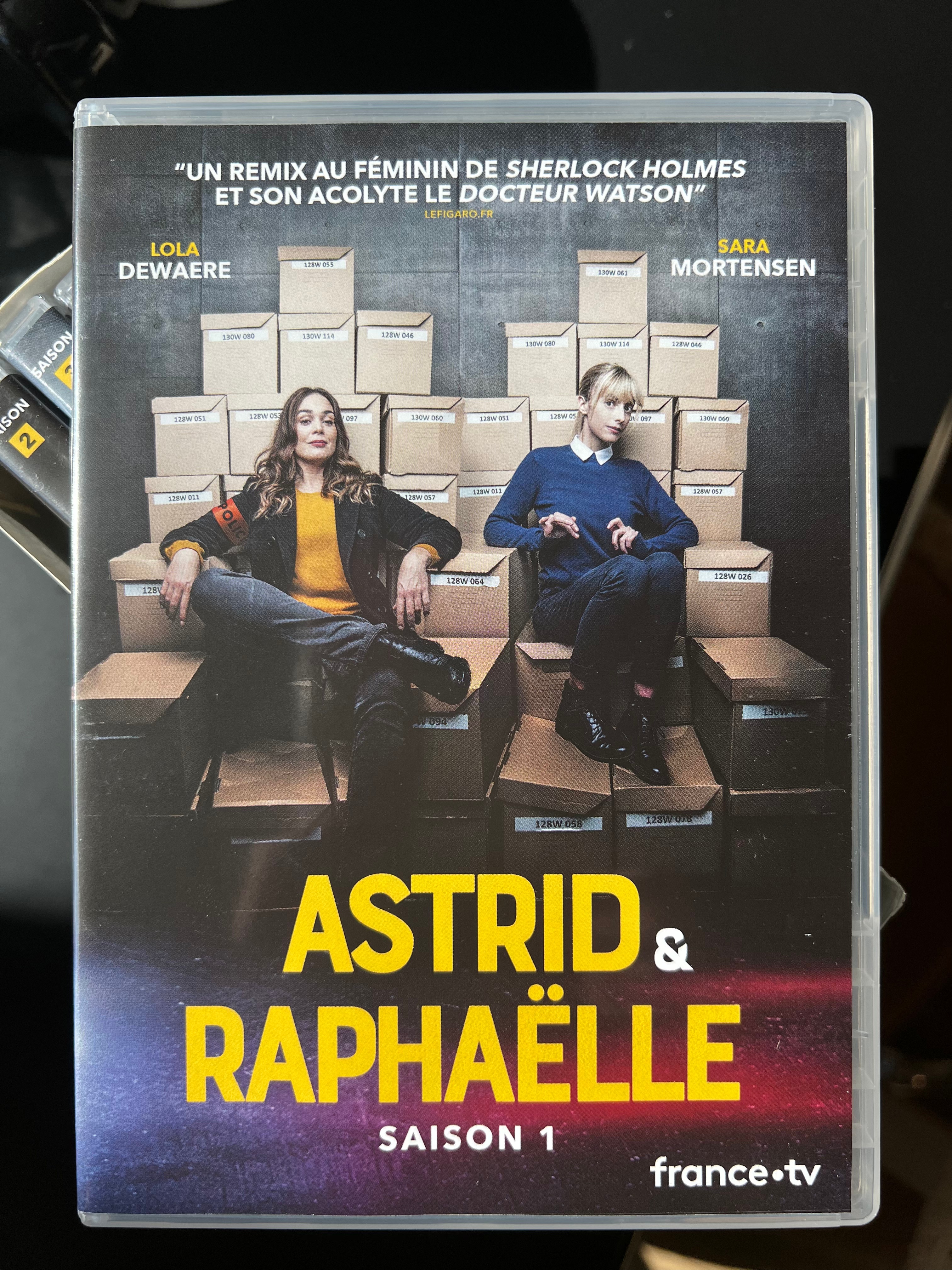
Game shows are a great way to start watching tv in your target language, because the scaffolding of an established game gives you context clues that aid comprehension, and there’s usually not as much use of more complex verb tenses. While I still love my French game shows, I’ve reached a point where I felt I was ready for more narrative-based tv, so I looked around the france.tv website and stumbled upon “Astrid et Raphaëlle”. Friends, I love this show. And it has 6 seasons! Heck yeah, love to discover a new favorite show and see you won’t be running out of it anytime soon.
“Astrid et Raphaëlle” is a sort of buddy cop (ugh I know but hear me out) meets odd couple story. Astrid is an autistic person who works in the criminal records archive, as what I suppose you could call a specialty librarian. (In the show they keep referring to her as a “criminaliste” but translating that directly into “criminologist” in English is not what she does.) Raphaëlle, neurotypical, is a detective in the police department. At first, difficulties and misunderstandings arise as they have to work together, but over the course of the first season, they learn to appreciate the other’s differences and become quite close friends. Oh and the crimes they solve fit one of my favorite tropes: mysteries where there appear to be a supernatural element at first but then it all turns out to be perfectly rational and based in our physical world.
One of my favorite jokes of the series thus far is when the two main characters are apprehensively walking through a supposedly haunted house at night, and Astrid tries to reassure Raphaëlle that there is no evidence that ghosts exist. Astrid then quickly follows up with “then again, there is also no evidence that ghosts don’t exist”, which got a hearty laugh out of me because that’s exactly the sort of thing I would say. Autistic people try to help, in our own way. I really appreciate the autistic representation in this show; it’s done very well.
I’m loving this show so much that I decided to buy a DVD set so I wouldn’t have to keep dealing with the ads and the often-janky connectivity of the france.tv website. It’s available on Amazon Prime but there’s no way to remove the English subtitles. (On the other hand, if you don’t speak French, this would be a great way to watch it!) I waited a solid couple weeks for my DVD set to arrive from overseas, and had to change the region on my Playstation to play region 2, amid stern warnings that I would only be able to change the region of the player four times, ever. That’s fine by me, because this probably won’t be the last French show I buy DVDs for. I’m learning French to live in French, after all.
References:
[1] https://bornfree.life/learn/2-2-1-diet/#:~:text=Glutaminolysis
[2] https://www.mdpi.com/2076-3921/13/4/439 — This review article found 7 studies that showed increased glutathione peroxidase activity (this is an enzyme that uses glutathione to reduce free radicals), and 3 that showed reduced levels of glutathione. Unfortunately, this article didn’t specify which 3 studies those were, and I didn’t dig into each and every citation in the References section to find them myself. Comparing glutathione peroxidase activity to glutathione levels is a little apples and oranges though, and one might reasonably suspect that if glutathione peroxidase activity is increased, level of certain forms of glutathione may temporarily decrease.
[3] https://pubmed.ncbi.nlm.nih.gov/16816830/
[4] https://pubmed.ncbi.nlm.nih.gov/7492947/
[6] https://www.sciencedirect.com/science/article/abs/pii/S0014299906002925
[7] https://www.nature.com/articles/s41598-020-63986-6
[8] I read this on Bluesky, and don’t remember the source. I found these two sources, both about 25 years old, but unfortunately neither of them cite a primary source for this information. I’m placing some trust in the Guardian to have hopefully fact-checked itself in conversation with a researcher at the time:
 Kate Violette