Time to read: 11-14 minutes.
(I like offering this up top so you know how much time you may be investing by choosing to read my words. But recently I noticed that the Ulysses app quotes shorter estimated times than WordPress does. So I’ve decided to start giving you a range!)
In this week’s newsletter:
2026 Goals Check-in!
Kate Film Club, 35 of 52: “Guess Who’s Coming to Dinner” (1967)
Book of the Week: “The Dispossessed”
French Study
As many people with complex illnesses know, it’s hard to tell if an improvement in symptoms or ability is just a passing fluke, or if it’s an actual baseline improvement that’s here to stay. And that makes things hard, because: 1. getting your hopes up only to have them dashed shortly thereafter majorly sucks, and, 2. it’s hard to plan your life when your ability/disability ratio is constantly in flux. Back when I started making gains in recovery late last summer, thanks to finally starting to treat Lyme, I knew I had to pick some sort of timescale that I would consider the gold standard of “I can trust this improvement now”. Otherwise my math brain (combined with my tender hopeful brain) would obsess anew at each improvement: counting the better days, and wondering how long it would last, and attempting to analyze what various lengths of lasting probably meant. I knew I needed to cut off at the pass that temptation to do faux math. Emotional support math, we might call it—math that doesn’t really serve any solid empirical end but that I’m just doing to pretend I have more control over the velocity of my recovery than I actually do.
So I just kind of metaphorically threw a dart at a dart board and decided on six months. If an improvement stuck around for six whole months, I would start to trust that it was actually here to stay. Some gains haven’t quite stuck yet, such as my ability to go on tiny walks regularly, which sort of waxes and wanes month-to-month: one month I might manage one short walk every week, sometimes two!, and the next month I only manage one total or even zero. But other improvements have stuck around, like being able to drive myself to all of my appointments again (unless I’m in a flare or crash).
It’s with this context in mind that I tell you, both excitedly and nervously, that I haven’t had to go to the ER for a mast cell attack since December of last year. Any MCAS attacks I’ve had, I’ve at least been able to manage them at home. I suspect there’s two reasons for this. First, it’s generally recognized that bartonella plays the biggest role among any of the Lyme bugs (borrelia and/or co-infections) in aggravating MCAS, possibly even causing it to begin with. And I’ve been treating bartonella since last December, albeit slowly, using a cytokine blockade I put together based on the Buhner bartonella book.
Second, I started a specialized combo supplement back in January (Aldosto-Ease, for those curious) that’s targeted to an angiotensin conversion issue my genetics suggest I may have. The practitioner I work with on genetic angles suspected that perhaps the extreme cardiovascular symptoms I get along with my most severe MCAS attacks are due to this angiotensin conversion issue, that it gets particularly kicked up when my body is being flooded with histamine and other related mediators. It’s even possible that my acute hypokalemia that sometimes presents along with my most severe MCAS attacks has been due to this particular conversion issue as well.
Part of me wants to ask: will 2026 be the first year that my MCAS doesn’t land me in the ER even once?! But one, let’s not tempt the ER gods like that, and two, my body gaining improved tolerance of stimuli (like foods with slightly higher histamine content) doesn’t mean I just get to sit around and enjoy the calm. Rather, it means I can start hitting my Lyme infections even harder, which in turn might still cause severe MCAS attacks. There’s no foolproof way to know exactly where your mast cells are drawing their table-flipping line that day except to try something and see what happens. (Every person that you know with MCAS is living in a constant state similar to the Simpsons meme with the kid on the bus laughing and saying “haha I’m in danger!”) So if it seems like my mast cells are ready to start tolerating a slightly faster rate of infection killing, then I want to take advantage of it. Heck yeah. But it might be a bit of a bumpy ride yet.
Before we hop into the usual sections, I want to mention that I’ve started a fledgling bookshop.org affiliate page and I’ll be highlighting there all of the books that I review on my blog as 3/5 stars or higher. (As I’ve talked about before, in my opinion 3/5 stars means good!) I’ll also be backfilling with a number of my highly recommended reads from years past, before I started this blog. The choices of what I add to my shop page are entirely independently mine, but I want to be transparent that I’ll earn 10% commission from purchases. As I begin to imagine what rebuilding my income-earning life looks like, I know that I’d like regular writing and reading to be part of it. It’ll be some time before I could sign up for a regular 40+ hrs/week W-2 type job again, and I have a little dream that maybe the work I figure out for myself in the interim could actually grow into my full-time work life by the time I’m ready to work that much again. I do hope that my tech management coaching and consulting business will form the bulk of my quilted-together work life, but I’m a big believer in the power of security through diversity, and I would like to have one main thing plus a few smaller things. So anyhow, if you enjoy my newsletter—and in particular my book reviews—I’d be thrilled if you might buy through my affiliate shop link now and then.
2026 Goals Check-in!
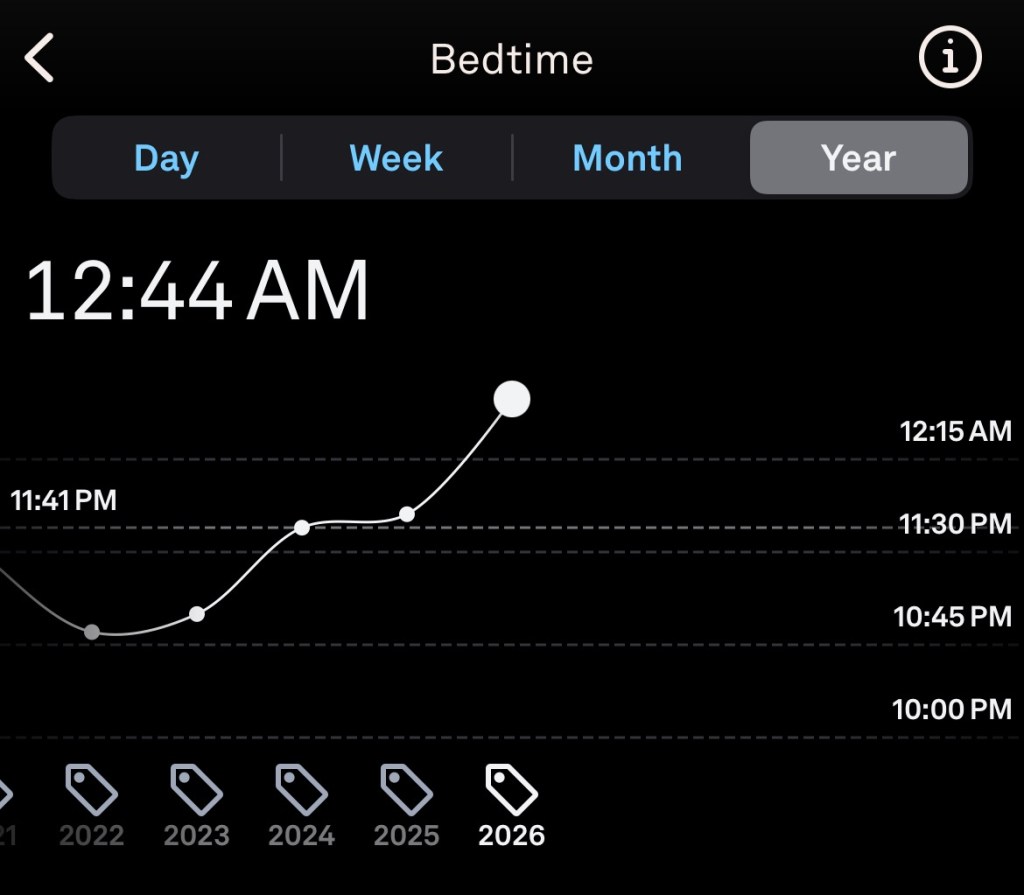
Welcome back to the section in which I keep myself publicly accountable for an earlier bedtime! I am displeased to report that I am doing 4 minutes worse on average than the last time I checked in here in May. Perhaps the sting of having to admit this more frequently, via getting my newsletter closer to actually weekly again, might help turn the tide. We shall see!
Kate Film Club, 35 of 52: “Guess Who’s Coming to Dinner” (1967)
I went in expecting it to be pretty bad and it at least wasn’t terrible. “Guess Who’s Coming to Dinner” starts off with a young, happy couple landing at SFO—the exterior shots of San Francisco from the 1960s were cool to see! The lady of the couple, Joanna, is white, and the gentleman of the couple, John, is Black. We quickly learn that the couple are on their way to surprise Joanna’s parents with a visit, to announce their engagement—ten days after having met each other. Joanna has absolute confidence that her politically progressive parents won’t have any qualms about their interracial marriage, while John, played by Sidney Poitier, has his doubts. At first, dinner that evening is just going to be Joanna’s parents and the happy couple, but then a priest friend and John’s parents—who fly up from Los Angeles for the occasion—also get invited. The growing guest list is a funny schtick. This movie was written directly for the screen but it plays out like a theater script, with most of the action being extended conversations in and around Joanna’s parents’ house.
I did a bit of reading to try to understand how the movie was reviewed at the time, and how its reviews have evolved since. The Supreme Court decision in Loving v. Virginia happened between the end of filming and the movie’s release, which made the following line about 6 months out of date by the time the film premiered: “Have you thought about what people would say about you? Why in 16 or 17 states you’d be breaking the law, you’d be criminals.” Probably the most succinct review I read called the movie “more well-intentioned than insightful”, and yeah, that about sums it up. Do you remember the movie “Bros”? I love Billy Eichner but that movie was pretty mediocre. On the other hand, it was one of the first times we got a rom-com about a gay couple from a major movie production company. I looked forward to its release for months!, but upon watching it, I was mostly left underwhelmed: well, I guess we (queers) get to have our own fluffy, not-that-good rom-coms now, too. That’s inclusion of a sort, I guess. “Guess Who’s Coming to Dinner” is kind of like that. It talked about interracial marriage, and love in general, from several different angles, but at its core it was mostly a saccharine rom-com with a side of politics.
And the politics, when they were meaningfully engaged with, were pretty hit or miss. Joanna’s parents being forced to confront their own surprise and possible hypocrisy was handled generously towards those characters, while still realistically enough for the historical context. But the writing and production teams didn’t put a lot of thought into the housekeeper’s arc, which was a record scratch in the attempted tidiness of a supposedly progressive narrative. I didn’t love the angry Black woman trope that somehow led to the only camera-twist shot of the whole movie (to make her seem extra angry, presumably). And I especially didn’t love that the whole movie ended with a monologue from a white guy. Are you kidding me? Old habits die hard I guess.
Hepburn won an Academy Award for Best Actress for this film, but really I think it’s Sidney Poitier who stole the show. If I were to do another “watch every movie this person ever was in” adventure, I might pick him. I was blown away by his ability to inhabit seemingly a dozen different emotions in a single scene, and to make his transitions among all of them entirely believable. I had never seen Poitier in action before, but now I get why he was so famous. I guess where I’m landing with this review is: it’s at least worth watching this movie for Poitier!
Rating: 3/5 – It’s fine for what it is. Fair warning you’ll definitely get the song “The Glory of Love” stuck in your head for several days afterward, though.
Where to watch: Streaming on Apple and Amazon.
Quote: “You are 30 years older than I am. You and your whole lousy generation believes the way it was for you is the way it’s got to be. And not until your whole generation has lain down and died will the dead weight of you be off our backs! You understand?! You’ve got to get off my back.”
Book of the Week: “The Dispossessed”
(by Ursula K. Le Guin, 1974; bookshop.org link)

Reviewing a Le Guin book is like making a sandwich from whatever you’ve got in your fridge for a Michelin-starred chef but here goes anyway.
I picked up and put down and picked back up this book a few times over the course of reading it, mostly due to life circumstances, but I’ll admit it was a little because of the book. I was worried the whole thing was building towards a nihilistic thesis, even though I’ve read “Time to Spare” and I know that’s not Le Guin’s bag. Still, I was worried she was attempting to say that all forms of governance suck, and thus that any attempts at building a more humanistic society are hopeless. But rather, I think the point she was driving at is: the only real societal change is individual change added up. People fixing their hearts one by one and learning how to love and how to be free.
“The Dispossessed” rotates on the axis of an idea that my own brain has been chewing on for years. For a long time I’ve thought the most sacred act is that of refusal: refusal to give in to evil or despair, refusal to betray one’s own values or self. But in other words, or perhaps the flip side of the same coin, it’s rather: “I accept this burden”. Like Frodo, like Faramir—the most sacred act is to step up to what your own inner compass asks of you, regardless of the heaviness of the burden. The main character in this book, Shevek, understands this. He leaves behind his family, friends, and the only planet he’s ever known, to try to bring his belief in a better world to another people who need it. The people he’s left see this as such a huge betrayal that he might very well never be able to return. Do you, reader, have any convictions that you would risk literally everything you have for? To become entirely dispossessed for?
I liked the bit at the end with the future view of Terra—in Le Guin’s Hanish cycle, that’s us, Earth. I don’t want to spoil it, but I will say: half a billion?!, holy shit. The references to Terran physics are also a fun wink, as a physics nerd. The extreme gender politics on Urras confused me though, as did her habit (during flashbacks on Annares in alternating chapters) of describing the less conventionally attractive parts of Shevek’s partner right before showing Shevek’s love for her. I’m not sure if Le Guin was attempting to say that sexism and capitalism are intertwined, but perhaps she was. And if she were, I’d agree with her. Still, my one criticism is my usual criticism about gender politics in Le Guin’s books: her reimagining is a start, but in how she seems to think about these things and play with them narratively, I don’t think she goes far enough. I am still left with the aftertaste of having read about gender from someone who is enlightened but nonetheless comes from the land of Gender As It Has Been Practiced On Earth For Millennia, rather than someone attempting to write about gender from scratch, from zero, from a foundation of radically throwing off the origins of the gender politics they were born into.
Yet all in all, it was a good read, and it made me think, and I’ll probably read it at least a second time one day.
Rating: 4/5 – It’s Le Guin. You don’t need me to tell you it’s great and that you should read it, but here I am doing it anyway!
French Study
I finished all six seasons of “Astrid et Raphaëlle” and I am here to tell you: go watch it! (There was one episode with sexual violence in it, and if you, like me, tend to avoid that in your visual media, find me on Bluesky and I’ll tell you which episode to avoid.) In the US, the show is available on PBS with English subtitles. It’s spectacular. I know the bar is low but still, it has the best representation of autism in any tv show I’ve yet watched, and the close friendship that drives the show is richly pitch perfect.
In other news, the place I take French classes from is now in its summer term, and while there was one brief review course I took, the last class of that is next week and then I will be without a regular French class until September! Sad face. I’ve been meaning to start up a daily journaling in French practice to improve my writing skills before attempting the B2 DELF this December, so perhaps I’ll use this time to get that off the ground.

